From Everyday Food & Life-Event Logs to Better Healthcare Conversations: Building an AI Nutrition Intelligence Platform
Food should nourish us, bring us joy, and support the people we care about. This project began with a personal goal: helping my wife better understand how meals, ingredients, daily routines, and other experiences might relate to how she feels. We care about ingredient quality and thoughtful food preparation, yet even with that care, everyday life makes meaningful patterns difficult to see.
I created an AI-powered nutrition and life-event intelligence platform combining conversational logging, structured clarification before data entry, validated schemas, dbt and BigQuery transformations, and exploratory machine learning. Its purpose is to organize observations and surface questions worth discussing with a qualified professional, not to diagnose conditions or assign causes to individual ingredients.
Why is it so hard to understand the relationship between food and how we feel?
Food is rarely experienced in isolation. Meals, preparation, sleep, physical activity, stress, and daily routines can overlap, while individual observations are often incomplete. That makes it hard to know which patterns deserve attention and which may be coincidental.
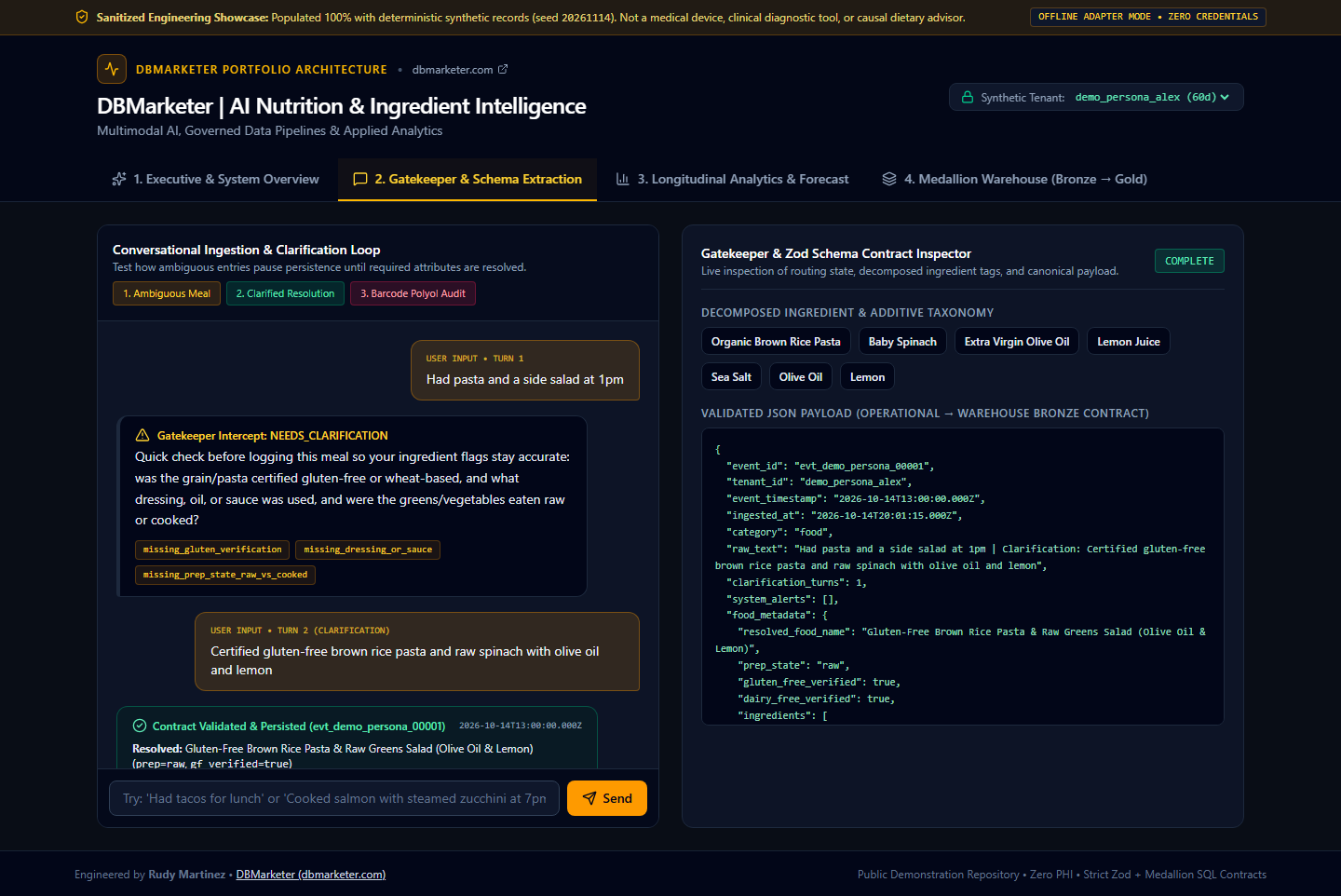
Conventional apps often force an unhelpful tradeoff. Rigid form-based trackers ask for so much detail across meals, activity, supplements, and symptoms that consistent tracking becomes a chore. Conversely, unchecked AI chat tools accept notes such as “I had pasta and salad” without asking about missing ingredients, dressing, preparation, or timing. A useful product must reduce logging effort while asking one concise follow-up when missing context matters, and treat timelines as input to clinical reasoning rather than a substitute for it.
What product decisions make daily observations more useful to review?
| Capability Layer | Connected Stack & APIs | Product & Analytical Role |
|---|---|---|
| 1. Conversational Capture & Gatekeeper | Telegram Bot API (text, voice, photo, barcode), React 19, Firebase, Google Gemini | Supports natural logging and asks one concise clarification before writing when key context is missing |
| 2. Ingredient & Excipient Checks | FatSecret OAuth 2.0 API + FDA & Monash FODMAP rules | Tags polyols (Maltitol E965 vs. Erythritol), gums, emulsifiers, and chewable supplement excipients |
| 3. Shared Timeline & Exploratory ML | dbt Core (Bronze -> Silver -> Gold) + BigQuery ML (XGBoost & ARIMA_PLUS) | Aligns prior 24h/48h food, sleep, movement, and regimen observations along a common timeline |
| 4. Literature Context for Visits | Semantic Scholar Graph API + Gemini MeSH query builder | Retrieves peer-reviewed study references related to recurring questions for clinician review |
How do analytical guardrails keep exploratory summaries honest?
- Questions for Review, Not Clinical Diagnoses: Exploratory associations display uncertainty intervals and sample counts as questions worth discussing with a qualified professional, not proof that an ingredient caused an outcome.
- Correlated-Feature Warnings in the Synthetic Demo: In our 60-day synthetic demonstration, two co-occurring ingredient categories report a synthetic risk ratio of
7.29xwhile boosted stumps assign85.3%and0.0%attribution. Automatedabs(r) >= 0.35checks highlight overlapping exposures rather than implying effects on a real person. - Modeled Baseline Intervals: Daily symptom scores in the synthetic demo are plotted against a rolling seven-day model-derived interval to distinguish ordinary fluctuation from periods that differ from the modeled baseline.
Explore the Project and Connect With DBMarketer
Start an Applied Analytics or AI Conversation
Inquire about applied AI workflows, product and longitudinal analytics, and evidence-based decision systems - as well as governed dbt/BigQuery architectures, telemetry audits, or principal advisory.